I am so far behind updating the History of the Universe, I know I will never complete the task.
I'm still going to work on it. I'm just not going to commit to how often.
Today's update is an article on the planet Esposi-2.
The whole Game web site is dedicated to David Allan, for reasons I have previously given.
I just want to add that this month, 37 years after the Game began, I am re-using a plot idea Dave gave me on day one. I'm running a story line I literally called "Ten Electrons". 37 years later, Dave is still in the Game.
And I still have the best players in the world.
How fast does a starship have to move? This is a question that took me a long time to answer. Because the answer dictates the whole feel of the world I'm trying to portray. Is travel between worlds slow and leisurely, like ocean liners, or fast like air travel? Whichever I choose, I'm either allowing or disallowing a whole set of story types.
Slow travel makes it impossible to react to an immediate crisis on other worlds. You can't save people from a natural disaster or stop a crime in progress if you're getting there a month after the news reaches you.
Fast travel doesn't give you leisure time to do anything _except_ react to immediate problems. You can't practice with your lightsaber if the jump to Alderaan only takes 10 minutes.
When thinking about speed, I started with a map and a history of the Emissariate of Bolusca and worked backwards. And to draw a map, I had a few pre-established facts from earlier stories that I had to accommodate. My chain of reasoning went as follows:
Now I had a key distance: 2.3 kiloparsecs. And because I had a history outline with "fixed points" that had to happen to coincide with known events on Earth, I knew that a fast ship had to go from Bolusca to Earth in approximately 40 days. So that sets a speed for the fastest ships of 2.3 kiloparsecs in 40 days, or almost 60 parsecs per day. Let's say it's 60 parsecs, because it's a round number, and because it allows a margin of the journey for course correction, engine maintenance, and other such things I can imagine a long journey needing. It's a little over 71,000 times the speed of light.
Journeying for 40 days in a cramped ship is a lot. Columbus only took 33 days to reach the Americas. But Bolusca to Earth is an exceptional journey. Most journeys between worlds in the Emissariate would be a lot shorter. But how short?
The average separation between stars in the milky way is about 1.5 parsecs. We know that a lot of stars have planets, but not all of the are suitable for life colonization, so let's say there's an average separation between inhabited worlds of six parsecs, a fairly arbitrary number but it will do. So the travel time for a fast ship between two planets could be as short as two and a half hours. Is that workable?
Yes, it actually is. It means you can really respond to emergencies on the next world over, but long journeys take days and weeks. It gives me a world that feels like the 1920s or 30s in terms of travel: easy to get between cities by car, train, or airplane; days or weeks to cross oceans by ship. And as I'm quite happy with reflecting the pulp era of science fiction, that works for me.
I can look at the extremes of the distance scale, too: the other side of the galactic core is around 16 kiloparsecs, which is around 270 days. So you could do it, but it's a really significant effort. The andromeda galaxy is 778 kiloparsecs, or around 35 years, and you'd have to be insane to try it. Within a single solar system, you can jump between planets almost instantaneously. I'm happy with those outcomes for plot reasons.
So now I have a pretty solid time and distance scale. Next I need to flesh out my map, placing key systems and making sure they are in the right places to allow the travel time I've already arbitrarily picked to make certain plots work. This is where it could all go horribly wrong...
I was recently asked what the Game looks like when we play it. It's a tough question to answer because it doesn't really look like a game. It looks like seven middle-aged men sitting around a table, talking, and making occasional notes. It looks like a board meeting:
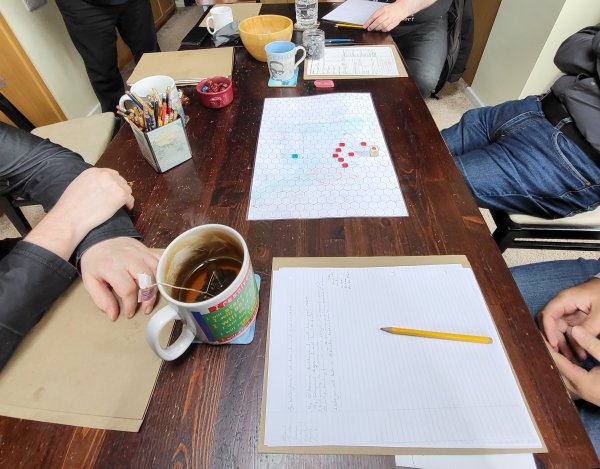
Because 90% of the Game takes place in our heads. We use some visual aids--my terribly drawn maps, or sometimes a plan with counters or models on it (that's what you see in the centre of the image above: my visual representation of the situation the players are in as they figure out how to board an enemy vessel without being overcome by a swarm of killer robots)--but they aren't the Game. The Game is pure imagination.
The Game looks like the week I spend thinking up a new storyline:

The Game looks like the hour I spend after each session updating my records:

The Game looks like the thousands of pages of documentation I've written (small section of it shown here):

The Game looks like the shelf-full of reference books I read to give it the illusion of believability:

The Game looks like the random notes I write in my plot book in the middle of the night, for reasons which escape me but which might get used for something one day:

But what the Game really looks like is entirely in the heads of the six players, because what they think it looks like is more important than all of the above. It looks like their ideas, and plans, and character interactions, and annoying, confounding, frustrating interactions with my plots. That's what the Game looks like to me. I have no idea what it looks like to them...
Sometimes I get hung up on unimportant details. I don't actually need deck plans for a Star Guard cruiser. But having them adds depth to the world. It lets me refer to it in a story and have everybody visualize what I mean.
This is just a rough first draft. We've already talked this through and come up with multiple improvements.

The key was getting the scale right. This is a ship where a team of Type-A personalities is going to live together for weeks on end, often isolated from contact with the rest of the universe. You need plenty of personal space. So each crew member gets a suite of rooms with about 60 square meters. You also need plenty of recreational areas, including a large area to train and hone your super powers.
With this scale decision made, the first problem is deck height. Because the ship is a sphere, making it that far across made it, obviously, the same height. This suddenly made each deck four metres high, which sounds ludicrous.
But in the best tradition of turning a problem into an asset, a four metre ceiling clearance means you've got space to accommodate extra-tall alien races, plus room for any crew member with the growth super-power to exercise it.
It's all coming together...
I just spent several minutes with a player, debating whether to put the teleport platform on the bridge deck or somewhere else. Actually, I was really just debating it with myself, thinking through the arguments out loud, while he waited for me to decide so he could update the deck plans.
Hold on, let me back up a step.
I was going to base the players' star ship on a Gazelle class close escort from an old Traveller game supplement. One of my players spent hours scanning the published deck plans, cleaning them up, and changing them according to my random whims. Then, last week, with around ten days to go before the new Game, I changed my mind. A close escort is too small, I needed to use the Broadsword class mercenary cruiser from a different Traveller supplement. The same player has spent hours scanning and cleaning up the deck plans, and of course I am making sweeping changes as things occur to me. So far, out of eight decks, I'm happy with our redesigned layout of just two of them. Five days to go before the Game...
Hold on, we're still in the middle of the story. Let me back up another step.
The Game that began with Strikeforce all those years ago has spent the last several years leaping between different time periods as I fill in the history of the entire universe. I have been slowly wrapping up the last six months of adventures set in World War Two, with the plan of setting the next six-month (or so) segment in outer space.
This was supposed to be easy, for three reasons.
(1) Every new era I play, I use a different set of rules; something that is appropriate to the era and style of Game I'm running. For the space era, I was going to go back to the Golden Heroes rules, which I used for the very first Game session thirty-odd years ago. The rules are simple, beautifully suit the super-hero genre (whether on Earth or in space), and we had spent so long playing them the first time round that it shouldn't take any effort to re-learn them.
(2) I also have to do a certain amount of research for each era (some more than others, depending on how "real" I want the Game to be), and this is a pretty big time sink (not to mention all the books I end up buying). By using a space-based science fiction setting, I don't need research. I can just make it all up.
(3) Finally, I have to actually create the setting: build the world, create characters to be friends and antagonists for the players, and seed enough plots to keep the Game running for six months. This should also have been easy this time around, as a lot of the work had already been done when Strikeforce encountered alien invaders (see for example the Crossfire storyline). So I was just going to re-use a lot of that.
So, not much work to do, right? I just need to throw together some simple plotlines.
And maybe create some planets.
Ok, lots of planets.
And new villains.
And make the political situation more nuanced.
Spreadsheet of travel time between planets, with a complicated algorithm for how warp speed works.
Don't forget the deck plans for the players' starship.
I've just read a scientific report on Betelgeuse going supernova, and I'm sure I can work that into a plot.
Collect character backgrounds from the players, and make notes on how to use or abuse those backgrounds for future story threads.
Have mental breakdown while reading some of the ridiculous ideas the players have come up with.
Spend several hours reading a submission from one player who is writing an entire novel to explain his character's background.
Ok, everything is done.
No, I just thought of a new set of villains. I'll need extra plot threads to tie them into.
Hold on, I hate these deck plans. Can we use a Broadsword class cruiser instead? Only change this, and this, and this. Invent a completely new scale for the deck plans because it's the wrong size. And add the teleport booth here. Wait, just leave it with me, I'll draw the new layout on graph paper. It will be fine, I've got five days and everything else is done.
OH MY GOD I'VE ONLY GOT FIVE DAYS AND NOTHING IS READY
