Showing posts with label Star Guard. Show all posts

Updates

 I was going to put another map here in the journal, then I realised I just ought to add it to the main site. So the Planetary Index now has a diagram of all known worlds' distance and bearing from Bolusca.

Well, almost all known worlds. While preparing it to put on line, I noticed I had missed a few worlds:

  • Fe-Rall
  • Krell
  • Plunderers Planet
  • Rufus

I think that's all. I'll add them at some future point, but for at least two of them I have no idea where they are located!

Mapping Space 2: The Frontier

 (Part 2 of a series on how to fight an interstellar war.)

As described in part 1, I had a usable map of the Emissariate of Bolusca, which included every star system so far identified in the game but had plenty of space to add more. With this, I could plot consistent travel times. I could have stopped there.

Except... it was on a square grid. And gamers like hexagonal grids for our maps. Why? I don't know, we just do. So for no reason other than "just because", I decided it was worth spending an entire day converting the map to a hex grid. This first step was easy, just trace the original map on to hex paper (you can click on any of these images to make them bigger, by the way):


To be honest, this was a bit rubbish. The main reason being the scale: 450 parsecs to a hex. On graph paper, I could use a ruler and measure down to the millimetre to get fairly exact distances. As soon as it's on hex paper, all I can easily say is, "It's in that hex," which means, "Somewhere within a 450 parsec area," which is next to useless for calculating accurate travel times. I needed a better scale. Which meant my map of known space wouldn't fit on a single sheet of paper. So I expanded just a small section of the border, and got this:


I'm at 100 parsecs per hex here, so this whole map covers an area about five hexes across on the previous one. I might need to drill down even more at some point, but this is a good working map for plotting grand strategy, and lets me map everything I need (so far) on just nine sheets of paper.

You can see I've already added several additional features to the map, because at this scale I can figure out how things will work:

  • The simple line of the border has become a "neutral zone" between the empires, 100 parsecs across.
  • I've added the border stations (the small x symbols on the Boluscan side of the neutral zone) that are supposed to warn of an invasion.
  • Because I've previously defined how hyperspace detection works, I know how far these stations need to "see" into enemy space, so I know the detection area around them (also marked on this map) and therefore how many stations I need to get full coverage of the border.
Just having this map has allowed me to set the strategy for the Krai invasion. I know where the Krai fleets need to start, and what their destinations should be. Those border stations are immediately obvious targets. Because although Krai fleets could jump right past them in hyperspace, the stations are going to be detecting their every move and relaying it back to the Boluscan fleets. Any sensible invasion has to start with preemptive strikes on all those stations. Knock them out on Day 1 of the war, and the Emissariate is blind; they can't know where you will strike next, so they can't intercept you with their own fleets. The Krai have total control of the war.

(Yes, I've read Sun Tsu and Clausewitz, and this is totally how they would fight if they had hyperspace drives.)

As a GM running a game, knocking out the border stations gives me a secondary (and much more important to me, though irrelevant to the Krai) advantage: I don't need to tell the players how the war is going. Each game session is now starting with some variation of "Psi Girl has called in from headquarters, we still don't have a clue where the Krai are."

I'm pretty happy with the map and (so far) with the war. The only slight problem I have is that I may have made the Krai strategy too good, because at the moment I can't see how the Emissariate will survive this.

But luckily for the Emissariate, they have the Star Guard...


Mapping Space

 I started the Star Guard campaign without a map, which is an extremely bad way to start a game (or a story), because without a map you can't tell how long it takes to get to places, and that leads to sloppy and inconsistent plotting. You basically end up with Star Wars, where a journey takes exactly as long as the plot needs it to take, and usually you don't even mention how long that is. It's ok in a blockbuster fantasy movie, but pretty terrible in a game (or any kind of hard-ish SF story).

Well, there was a kind of map of Known Space. At the start, this is all I needed. It showed me how much space I had to move around in, which let me work out how fast starships could sensibly travel (this was covered in an earlier journal post, Measuring Space). 

But as I said at the conclusion that earlier post, "This is where it could all go horribly wrong."

And it did go horribly wrong. I should have started constructing a map as soon as I had two planetary systems, so I knew exactly how far apart things were. Instead, I kept adding new systems and separating them by how far I needed them to be for story purposes. After two years of play, I had this:


Pairs of star systems with the travel time between them. It should be immediately obvious why this is doomed to fail. Pick any three systems. I know the distance from A to B and B to C. What's the distance from A to C? It's literally impossible to calculate. You can construct infinite triangles made up of those three vertices, with infinite variations of length AC.

So I started slowly and painfully putting these systems into a spatial relationship to each other, maintaining the distances I had already established between each pair. It took a lot of trial and error, adding systems to a map and then erasing them and moving them somewhere else when the numbers didn't add up. I was convinced it would actually be impossible. But after a lot of work, I got this:


(This is just a small portion from the middle of the page.)

And, miraculously it worked. Everything is the right distance from everything else, matching every distance I had recorded.

This is pure luck. There's no way it should have worked. 

But now I had a map, with consistent spatial relationships that supported every piece of travel time data currently established in the game. Now, I could fight a proper interstellar war...

One more point: my map is on a flat piece of paper, and space is of course three dimensional. Making a 3D map would have been an order of magnitude harder, and for story purposes it's not necessary. Because due to the nature of hyperspace, travel distances between stars map to a two-dimensional galactic plane. Why? Because they do. It's my hyperspace, and it works however I decide. Make your own game if you don't like it!

Coming soon: hex maps!


Plotting a War

I mentioned last time that I've spent four months plotting a war. The timing of the war is critical, as the date of the invasion of Earth is a fixed point in Strikeforce history. I had to start the war on a specific date to give the Krai time to get to Earth by the established invasion date (don't worry if this isn't making sense, I hope I'll clear it all up in future posts).

As that critical date approached in the Star Guard campaign, I was completely unprepared to run a war. To give myself the breathing space I needed to do it, I put the Star Guard on hold and switched to a different campaign (more on that later, too) for four months.

Four months later, I've got the strategic thrust of the war mapped out, and a number of potential scenarios planned. The idea is that the Star Guard (the player characters) will be sent on missions to worlds threatened by the Krai invasion—which is why I need to know where that invasion is on any particular date, which I why i needed to "play" the war in advance.

One week in and it's already gone wrong, as an event I wanted to happen didn't happen, thanks to player activity, so I've got to tweak my war strategy slightly. But I've got two or three scenarios lined up that can happen regardless of where the Krai front line is, so I think I'm ok.

I feel like I'm not explaining this very coherently.

Let's try this instead: this handout was given to the players to show them what their characters knew on the eve of the war (and refresh their memories after four months of not playing these characters). Now you know everything they know. I don't yet have an established place to put this file on the main site, so consider this a sneak preview of a new storyline coming soon.

Two Years of the Star Guard

 It seems that I missed the two-year anniversary of starting the Star Guard story on 1st July 2023. Not that the anniversary means anything, but it's an excuse to waffle about the Star Guard, and I've been very lax about waffling on this blog. Maybe I've said some of the following before, but if I can't remember then I'm sure my readers can't either, so I'm going to say it again.

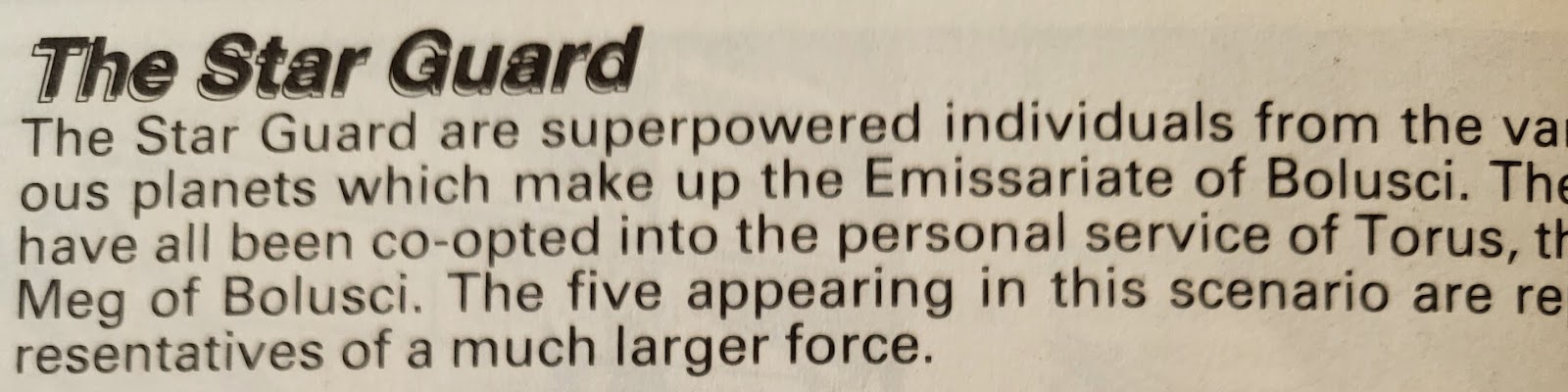
I didn't invent the Star Guard. They were introduced in the original Golden Heroes rules, which I talked about in a previous post. The introduction gave a huge amount of detail:

(I've just noticed that somewhere down the line I changed Bolusci to Bolusca, probably because I simply misremembered how it was written in the book. I also just rediscovered that the Meg has a proper name, Torus, which I have never used because I completely forgot about it.)

But this was all the detail I needed to use the group as antagonists in a Strikeforce scenario in 1988. That episode has been written up as chapters 13 and 14 of the Strikeforce story, if you want to see how I used them.

They came back a couple more times in later Strikeforce stories, and I started adding the additional members that the original paragraph hinted at. This was fairly easy, because I could recognise a Legion of Super-Heroes homage when I saw it, and I can homage with the best of them.

But I didn't need to put much effort into fleshing out what the "Emissariate of Bolusca" actually was, or why it had such an unwieldy name. (I eventually figured that last part out: it's a Federal political system, with member planets being semi-autonomous self-governing states and each sending an "Emissary" (like a senator) to represent them on the "Emissariate Council" (Federal government). This works, because the Star Guard can then act like the FBI, with the power to operate across "state lines" and deal with incidents that the Planetary Police in isolation can't or won't. But the politics of this set-up is probably something that needs an entire article to itself.)

So two (and a bit) years ago I had to expand the Star Guard's setting beyond just having a few defined characters to having an entire, detailed, coherent universe for them inhabit. My last two years have been almost exclusively devoted to doing that (which is why documentation of the rest of the Heroes Universe has dwindled to almost nothing). It's nowhere near complete, as all I have time to do is scramble to keep ahead of where the players are travelling next, and to head off any annoying questions they may raise about it. A lot of stuff is in fragmentary notes in my plot book, some of it is only in my head, and a very small portion of it is actually properly documented on the Heroes Universe site. So if you want to read about some of the

then you (now) know where to find them.

This week I've just been updating and improving the index pages linked above, but if you want to see what new pages have been added recently it's always listed on the home page.

There's some other stuff I was going to say, but I'll save it for a later post. Hopefully not too much later.

Too Many Names

I have been running the Star Guard campaign for less than two years (though plotting it for longer than that), and in that time I have created 161 characters. That includes every character important enough to have name; there are many more unnamed "extras".

To put this in some context: the original Strikeforce story had around 400 named characters before I gave up counting, and many more than that by the end.

Some of those characters are extremely minor, and I could sum up their role in a couple of sentences. Others have pretty detailed backgrounds and play major, or at least recurring minor, parts in the story. Eventually, I'll have all of their background written down. But to remind myself how much I've still got to write, I've made a list, the Encyclopaedia Galactica Biographical Index.

In a future blog post, I will apologise for my compulsion to use awful puns in character names. But not today.

Updates

 Two new articles in the Encyclopaedia Galactica section:

That's all for this week. More strange new worlds and new life and new civilizations coming soon. And maybe a timeline of the Emissariate. Maybe that should be my next big project.

Updates

 No new pages this time, but updates to a couple of existing pages:

  • The Star Guard membership membership roll call has been expanded to include more current members. A few historical details have been corrected or tidied up.
  • The list of Galactic Threats has been expanded with new entries.
Next time I get a chance to update, I'm going to add pages for some more of the planets listed in the Encyclopaedia Galactica.

Measuring Space

How fast does a starship have to move? This is a question that took me a long time to answer. Because the answer dictates the whole feel of the world I'm trying to portray. Is travel between worlds slow and leisurely, like ocean liners, or fast like air travel? Whichever I choose, I'm either allowing or disallowing a whole set of story types.

Slow travel makes it impossible to react to an immediate crisis on other worlds. You can't save people from a natural disaster or stop a crime in progress if you're getting there a month after the news reaches you.

Fast travel doesn't give you leisure time to do anything _except_ react to immediate problems. You can't practice with your lightsaber if the jump to Alderaan only takes 10 minutes.

When thinking about speed, I started with a map and a history of the Emissariate of Bolusca and worked backwards. And to draw a map, I had a few pre-established facts from earlier stories that I had to accommodate. My chain of reasoning went as follows:

  1. The Emissariate could only occupy a small part of the galaxy because I had other aliens defined as coming from the far side of the galaxy.
  2. The black hole Cygnus X-1 is a real-world object about 2.2 kiloparsecs from Earth, and I had a plot arising from the original Strikeforce story that I wanted to use. This means it had to fall within Emissariate space.
  3. But I didn't want it deep in Emissariate space; somewhere near one border would be better.
  4. Let's put Bolusca about 2.3 kiloparsecs from Earth, then, and have its borders extend roughly 2.3 kiloparsecs in all directions, putting Cygnus X-1 somewhere out near, but not right at, the Krai border.

Now I had a key distance: 2.3 kiloparsecs. And because I had a history outline with "fixed points" that had to happen to coincide with known events on Earth, I knew that a fast ship had to go from Bolusca to Earth in approximately 40 days. So that sets a speed for the fastest ships of 2.3 kiloparsecs in 40 days, or almost 60 parsecs per day. Let's say it's 60 parsecs, because it's a round number, and because it allows a margin of the journey for course correction, engine maintenance, and other such things I can imagine a long journey needing. It's a little over 71,000 times the speed of light.

Journeying for 40 days in a cramped ship is a lot. Columbus only took 33 days to reach the Americas. But Bolusca to Earth is an exceptional journey. Most journeys between worlds in the Emissariate would be a lot shorter. But how short?

The average separation between stars in the milky way is about 1.5 parsecs. We know that a lot of stars have planets, but not all of the are suitable for life colonization, so let's say there's an average separation between inhabited worlds of six parsecs, a fairly arbitrary number but it will do. So the travel time for a fast ship between two planets could be as short as two and a half hours. Is that workable?

Yes, it actually is. It means you can really respond to emergencies on the next world over, but long journeys take days and weeks. It gives me a world that feels like the 1920s or 30s in terms of travel: easy to get between cities by car, train, or airplane; days or weeks to cross oceans by ship. And as I'm quite happy with reflecting the pulp era of science fiction, that works for me.

I can look at the extremes of the distance scale, too: the other side of the galactic core is around 16 kiloparsecs, which is around 270 days. So you could do it, but it's a really significant effort. The andromeda galaxy is 778 kiloparsecs, or around 35 years, and you'd have to be insane to try it. Within a single solar system, you can jump between planets almost instantaneously. I'm happy with those outcomes for plot reasons.

So now I have a pretty solid time and distance scale. Next I need to flesh out my map, placing key systems and making sure they are in the right places to allow the travel time I've already arbitrarily picked to make certain plots work. This is where it could all go horribly wrong...


Space ship!

Sometimes I get hung up on unimportant details. I don't actually need deck plans for a Star Guard cruiser. But having them adds depth to the world. It lets me refer to it in a story and have everybody visualize what I mean. 

This is just a rough first draft. We've already talked this through and come up with multiple improvements.


The key was getting the scale right. This is a ship where a team of Type-A personalities is going to live together for weeks on end, often isolated from contact with the rest of the universe. You need plenty of personal space. So each crew member gets a suite of rooms with about 60 square meters. You also need plenty of recreational areas, including a large area to train and hone your super powers.

With this scale decision made, the first problem is deck height. Because the ship is a sphere, making it that far across made it, obviously, the same height. This suddenly made each deck four metres high, which sounds ludicrous.

But in the best tradition of turning a problem into an asset, a four metre ceiling clearance means you've got space to accommodate extra-tall alien races, plus room for any crew member with the growth super-power to exercise it.

It's all coming together...

Changing the Guard

I just spent several minutes with a player, debating whether to put the teleport platform on the bridge deck or somewhere else. Actually, I was really just debating it with myself, thinking through the arguments out loud, while he waited for me to decide so he could update the deck plans.

Hold on, let me back up a step.

I was going to base the players' star ship on a Gazelle class close escort from an old Traveller game supplement. One of my players spent hours scanning the published deck plans, cleaning them up, and changing them according to my random whims. Then, last week, with around ten days to go before the new Game, I changed my mind. A close escort is too small, I needed to use the Broadsword class mercenary cruiser from a different Traveller supplement. The same player has spent hours scanning and cleaning up the deck plans, and of course I am making sweeping changes as things occur to me. So far, out of eight decks, I'm happy with our redesigned layout of just two of them. Five days to go before the Game...

Hold on, we're still in the middle of the story. Let me back up another step.

The Game that began with Strikeforce all those years ago has spent the last several years leaping between different time periods as I fill in the history of the entire universe. I have been slowly wrapping up the last six months of adventures set in World War Two, with the plan of setting the next six-month (or so) segment in outer space.

This was supposed to be easy, for three reasons.

(1) Every new era I play, I use a different set of rules; something that is appropriate to the era and style of Game I'm running. For the space era, I was going to go back to the Golden Heroes rules, which I used for the very first Game session thirty-odd years ago. The rules are simple, beautifully suit the super-hero genre (whether on Earth or in space), and we had spent so long playing them the first time round that it shouldn't take any effort to re-learn them.

(2) I also have to do a certain amount of research for each era (some more than others, depending on how "real" I want the Game to be), and this is a pretty big time sink (not to mention all the books I end up buying). By using a space-based science fiction setting, I don't need research. I can just make it all up.

(3) Finally, I have to actually create the setting: build the world, create characters to be friends and antagonists for the players, and seed enough plots to keep the Game running for six months. This should also have been easy this time around, as a lot of the work had already been done when Strikeforce encountered alien invaders (see for example the Crossfire storyline). So I was just going to re-use a lot of that.

So, not much work to do, right? I just need to throw together some simple plotlines.

And maybe create some planets.

Ok, lots of planets.

And new villains.

And make the political situation more nuanced.

Spreadsheet of travel time between planets, with a complicated algorithm for how warp speed works.

Don't forget the deck plans for the players' starship.

I've just read a scientific report on Betelgeuse going supernova, and I'm sure I can work that into a plot.

Collect character backgrounds from the players, and make notes on how to use or abuse those backgrounds for future story threads.

Have mental breakdown while reading some of the ridiculous ideas the players have come up with.

Spend several hours reading a submission from one player who is writing an entire novel to explain his character's background.

Ok, everything is done.

No, I just thought of a new set of villains. I'll need extra plot threads to tie them into.

Hold on, I hate these deck plans. Can we use a Broadsword class cruiser instead? Only change this, and this, and this. Invent a completely new scale for the deck plans because it's the wrong size. And add the teleport booth here. Wait, just leave it with me, I'll draw the new layout on graph paper. It will be fine, I've got five days and everything else is done.

OH MY GOD I'VE ONLY GOT FIVE DAYS AND NOTHING IS READY