The web site to a new host. This will result in a bit of down time while everything get configured. This Journal part of the site will still be available because it's hosted separately.
Missing Players
Sometimes when you're playing a game, you have a player who can't be there for some reason. There are a number of ways to deal with it. If you're in the middle of an adventure, you do your best to continue it while you (as GM) play the missing player's character as fairly as you can. If you're about to start a new adventure, you simply assume the player's character is somewhere else that day, and go on without him.
Or, if you have enough advance notice, you prepare a game that can only take place when the player is absent. For example, when Avatar's player was away for one session, I had Avatar kidnapped by a demon. I couldn't do that if the player was present. Well, I could, but it wouldn't be fair on him to make him just watch, completely uninvolved, while the other players tried to rescue him.
So, Strikeforce chapters 17 and 18: it's all Avatar's player's fault.
It's also the pivotal story of the entire 39-year Game, as I may have mentioned.
Best Plan Ever?
Sometimes in a Game you throw a no-win situation at the players. I don't mean you kill them all with an undefeatable monster (though actually... I've done that too), but you give them a dilemma in which every solution has unpalatable consequences, so you're forcing them to make a moral choice to decide which is the lesser of two evils. Depending on what they choose, you follow through with the consequences and the Game changes as a result.
Sometimes, you wait for them to realise that they have two unpalatable options, and out of the blue they come up with a third way you've never even considered, one which you hadn't planned for and probably shouldn't allow, but which is so awesomely argued (within the established framework of the Game universe, and all in character, no "cheating" with knowledge the characters shouldn't have) that you just have to allow it, even if it means completely chucking out future plot lines that you've spent weeks working out in anticipation of the "defeat".
This is one such plan proposed by a player's character in the Game. In his own words:
Perhaps either the Event Field is 'indestructible' and interference is pointless, or the consequences to the Universe itself will be far worse than mere interstellar conflict if it's artificially extinguished. So I'd like to propose a compromise, a third alternative. Why don't you utilise the Dream Weaver Device to divert rather than eliminate the effect? I propose a three stage process, which will necessarily require use of the Device and the absolute trust and co-operation of everybody involved. Firstly, over the area of space-time encompassing the Event horizon itself, amend a basic Physical Law. Instead of being Mass multiplied by Velocity, briefly define Momentum as being equal to Mass multiplied by Speed. Secondly, curve that area of space time, nudging the direction of travel of the Event in space by ninety degrees i.e. perpendicular to its previous direction of travel. Thus we would have a rotating rather than an expanding phenomenon around the Earth. With our adjusted definition of Momentum, the direction component of velocity is not an issue thus Conservation of Momentum / Energy is conserved. Thirdly, restore the previous definition of Momentum to the area of space time previously affected. The Event phenomenon has not been destroyed, merely 'steered' and contained into a constantly rotating and non expanding configuration! The Event itself isn't to be targeted, merely the area of space-time it occupies.
Best. Players. Ever.
Astra
I wrote this some years ago, but wasn't sure I wanted to include it here. But a conversation yesterday reminded me of it, and I think that if it was important enough for me to write then it's worth sharing. So here it is.
Writing is hard
Today's game was emotionally hard for me to run. When I plotted the current story line some months ago, I knew I had to play out one scene that, well, every time I rehearsed the dialogue to myself I just broke down.
I'm not sure if people who don't play RPGs realise how attached you can get to a character.
One of the very first characters I created for the original Strikeforce game was Astra. Originally a villain, then as I developed her background I realised she worked better as a hero, and eventually she joined Strikeforce and grew into a better person than I ever could have planned for. Grew from a timid and unsure teenage girl coerced into crime, into a strong, confident, and capable woman.
Maybe it sounds stupid to talk like this about a fictional character—particularly one that I had created myself—but I was so proud of her. And I guess I loved her, as much as you can love a fictional character.
And the players reinforced that. They took the character to their hearts, and literally enabled, even pushed through, the story arc that saw her transition to a hero. Their characters completely embraced Astra as a friend and comrade. As usual, it's the players who are responsible for making the game work, not me. When I ran a scenario that was literally Astra's 18th birthday party, everyone put effort into picking the perfect gifts. When her boyfriend cheated on her, one of the players sat in the kitchen with me and in-character we ate ice cream together. (And I'm going to completely gloss over how weird it is for a grown man to act the part of a teenage girl having a birthday party; that's just how games work.)
When I moved the game "Twenty Years Later", Astra returned as an adult, and everyone knew that was the right thing to happen.
Then, when I started filling in the historical eras of the story, a big part of that was filling in Astra's genealogy. (See if you can spot her ancestor in the Atlantis story. Your clue is that "Setara" means "Star" in Persian, and as we all know, Persian is one of the languages rooted in ancient Atlantean.)
Ok, if you're still here, I'm getting to the point now.
The current phase of the game is set in 1975, and is a prequel story set 12 years before the original Strikeforce story.
So the current crop of player-run heroes are gathered at Wang's shop in San Francisco's Chinatown, in 1975, to discuss their plan to take down the local crime boss (which is the main plot of the current game). The characters don't know Wang, even though the players do. Wang is a minor character in the Strikeforce story, and I hope the players think that I've introduced the younger version of him here to tell his background story as an "easter egg" for them, irrelevant to the actual plot. But I'm not telling Wang's story. I'm telling Astra's.
Wang sells cheap souvenirs to tourists. There are three of them in the shop right now: a young couple and their four-year-old daughter. While the player-characters watch (but don't intervene, because it's nothing to do with their plot, it's just a side scene I'm playing out for their benefit), the girl asks her father to buy her a colourful paper lantern for $5. Her father tells her it's over-priced rubbish and refuses. The girl is upset.
And then Wang, who I've spent the last couple of weeks establishing as a short-tempered, self-absorbed, money-grabbing con-man, inexplicably kneels down and hands the girl a lantern. And says—and this is the dialogue that kills me, and you won't understand it unless you know the history of Strikeforce, and Wang, and especially Astra, and I think I hold it together so my friends don't notice, I think I say it without my voice cracking—
"For you, little girl, it will never cost five dollars."
And Astra leaves the shop with her parents, and minutes later there's huge smashing noise outside, and the heroes rush out to find both parents dead in a car crash.
I've just orphaned my favourite character.
Because that's already part of her history, it was established when I first introduced her all those years ago. But knowing it has happened is different from describing it happening.
It's so different.
It's so hard.
What I Did on my Holidays
As mentioned, I took a break from the Star Guard to give myself time to get ahead of plotting the Krai war which is supposed to dominate the story for the foreseeable future.
I told the players I needed about a month, and I would fill the month with a different game. I wanted something that wouldn't take much mental effort or preparation time from me, so that I could concentrate on plotting for the Star Guard. So I picked a setting I had already put a lot of thought into: Earth, in the year 2075, the dystopian future of the post-Strikeforce era. I had the setting worked out in reasonable detail, I had the flow of the campaign worked out, and I had picked a rules system to use. Literally, I had been thinking about this since almost the start of the "historical" game sequences, over ten years ago. It should have run itself.
You know there's going to be a "but"...
But this was the rules system I wanted to use:
Car Wars, published by Steve Jackson Games in the early 1980s (and still available in an updated edition).My theory of RPGs is that the rules are the least important part of them. If you're creating a character, the personality you put into the character is the most important--actually, the only important--thing, and that comes entirely, 100%, from the mind of the player, not from a set of rules.
And I have the best players in the world. I was confident that with a starting point as ridiculous as "you're the driver of a car and your job is to shoot other cars", I would get a set of diverse, interesting, and fully-formed characters. And I did.
I'll go into that later. First, here's the world of 2075. As with all games, it starts with the background and a reason for the characters to engage with it:
- The world of 2025
- The Winkernickle Foundation
- Swan Technology Strategies
- Rookie Night in Pittsburgh
- Road Quad Cargo Carrier
- Truck Stops
Updates
I was going to put another map here in the journal, then I realised I just ought to add it to the main site. So the Planetary Index now has a diagram of all known worlds' distance and bearing from Bolusca.
Well, almost all known worlds. While preparing it to put on line, I noticed I had missed a few worlds:
- Fe-Rall
- Krell
- Plunderers Planet
- Rufus
I think that's all. I'll add them at some future point, but for at least two of them I have no idea where they are located!
Mapping Space 2: The Frontier
(Part 2 of a series on how to fight an interstellar war.)
As described in part 1, I had a usable map of the Emissariate of Bolusca, which included every star system so far identified in the game but had plenty of space to add more. With this, I could plot consistent travel times. I could have stopped there.
Except... it was on a square grid. And gamers like hexagonal grids for our maps. Why? I don't know, we just do. So for no reason other than "just because", I decided it was worth spending an entire day converting the map to a hex grid. This first step was easy, just trace the original map on to hex paper (you can click on any of these images to make them bigger, by the way):
To be honest, this was a bit rubbish. The main reason being the scale: 450 parsecs to a hex. On graph paper, I could use a ruler and measure down to the millimetre to get fairly exact distances. As soon as it's on hex paper, all I can easily say is, "It's in that hex," which means, "Somewhere within a 450 parsec area," which is next to useless for calculating accurate travel times. I needed a better scale. Which meant my map of known space wouldn't fit on a single sheet of paper. So I expanded just a small section of the border, and got this:
- The simple line of the border has become a "neutral zone" between the empires, 100 parsecs across.
- I've added the border stations (the small x symbols on the Boluscan side of the neutral zone) that are supposed to warn of an invasion.
- Because I've previously defined how hyperspace detection works, I know how far these stations need to "see" into enemy space, so I know the detection area around them (also marked on this map) and therefore how many stations I need to get full coverage of the border.
Mapping Space
I started the Star Guard campaign without a map, which is an extremely bad way to start a game (or a story), because without a map you can't tell how long it takes to get to places, and that leads to sloppy and inconsistent plotting. You basically end up with Star Wars, where a journey takes exactly as long as the plot needs it to take, and usually you don't even mention how long that is. It's ok in a blockbuster fantasy movie, but pretty terrible in a game (or any kind of hard-ish SF story).
Well, there was a kind of map of Known Space. At the start, this is all I needed. It showed me how much space I had to move around in, which let me work out how fast starships could sensibly travel (this was covered in an earlier journal post, Measuring Space).
But as I said at the conclusion that earlier post, "This is where it could all go horribly wrong."
And it did go horribly wrong. I should have started constructing a map as soon as I had two planetary systems, so I knew exactly how far apart things were. Instead, I kept adding new systems and separating them by how far I needed them to be for story purposes. After two years of play, I had this:
So I started slowly and painfully putting these systems into a spatial relationship to each other, maintaining the distances I had already established between each pair. It took a lot of trial and error, adding systems to a map and then erasing them and moving them somewhere else when the numbers didn't add up. I was convinced it would actually be impossible. But after a lot of work, I got this:
But now I had a map, with consistent spatial relationships that supported every piece of travel time data currently established in the game. Now, I could fight a proper interstellar war...
One more point: my map is on a flat piece of paper, and space is of course three dimensional. Making a 3D map would have been an order of magnitude harder, and for story purposes it's not necessary. Because due to the nature of hyperspace, travel distances between stars map to a two-dimensional galactic plane. Why? Because they do. It's my hyperspace, and it works however I decide. Make your own game if you don't like it!
Coming soon: hex maps!
Plotting a War
I mentioned last time that I've spent four months plotting a war. The timing of the war is critical, as the date of the invasion of Earth is a fixed point in Strikeforce history. I had to start the war on a specific date to give the Krai time to get to Earth by the established invasion date (don't worry if this isn't making sense, I hope I'll clear it all up in future posts).
As that critical date approached in the Star Guard campaign, I was completely unprepared to run a war. To give myself the breathing space I needed to do it, I put the Star Guard on hold and switched to a different campaign (more on that later, too) for four months.
Four months later, I've got the strategic thrust of the war mapped out, and a number of potential scenarios planned. The idea is that the Star Guard (the player characters) will be sent on missions to worlds threatened by the Krai invasion—which is why I need to know where that invasion is on any particular date, which I why i needed to "play" the war in advance.
One week in and it's already gone wrong, as an event I wanted to happen didn't happen, thanks to player activity, so I've got to tweak my war strategy slightly. But I've got two or three scenarios lined up that can happen regardless of where the Krai front line is, so I think I'm ok.
I feel like I'm not explaining this very coherently.
Let's try this instead: this handout was given to the players to show them what their characters knew on the eve of the war (and refresh their memories after four months of not playing these characters). Now you know everything they know. I don't yet have an established place to put this file on the main site, so consider this a sneak preview of a new storyline coming soon.
Priorites
When I started this project, I had some vague idea that I could document everything from 39 (now) years of the Game.
It's not going to happen. I fall further and further behind.
Given a choice between writing something that I need to run the current Game now, or something that documents past history, I'm going to write the current piece, and I'm not often going to write it in a way that's publishable. I have a duty to run a new Game scenario every week of the year (almost), and that takes time to plot.
The only way this site will ever be complete, with all the Game documented in full, is if I stop the Game. And they won't let me do that. I've tried. Twice. And they keep dragging me back.
But I've spent the bulk of the last four months plotting out the current Game months into the future (more on this later), which should reduce my general planning burden and let me write more here. Maybe. Let's see...
Naming Things
Naming things is hard. Naming things in a science fiction setting is even harder. You need a name which sounds non-English, but which is still pronounceable.
I just tried to call a starship Intrepid, and mistyped it as Interpid, and I think I'm going to keep that spelling, just because I can.
Two Years of the Star Guard
It seems that I missed the two-year anniversary of starting the Star Guard story on 1st July 2023. Not that the anniversary means anything, but it's an excuse to waffle about the Star Guard, and I've been very lax about waffling on this blog. Maybe I've said some of the following before, but if I can't remember then I'm sure my readers can't either, so I'm going to say it again.
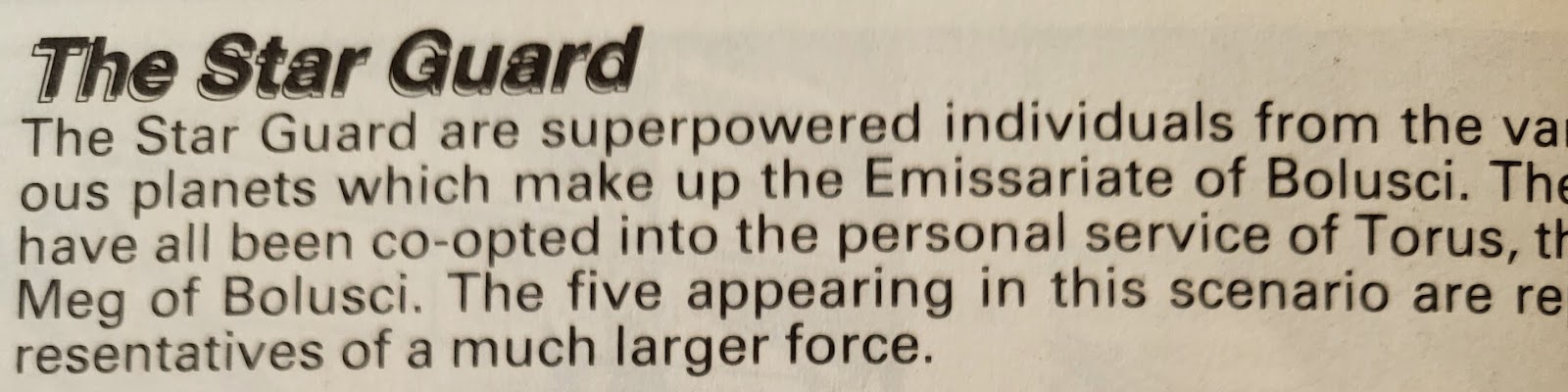
I didn't invent the Star Guard. They were introduced in the original Golden Heroes rules, which I talked about in a previous post. The introduction gave a huge amount of detail:
(I've just noticed that somewhere down the line I changed Bolusci to Bolusca, probably because I simply misremembered how it was written in the book. I also just rediscovered that the Meg has a proper name, Torus, which I have never used because I completely forgot about it.)
But this was all the detail I needed to use the group as antagonists in a Strikeforce scenario in 1988. That episode has been written up as chapters 13 and 14 of the Strikeforce story, if you want to see how I used them.
They came back a couple more times in later Strikeforce stories, and I started adding the additional members that the original paragraph hinted at. This was fairly easy, because I could recognise a Legion of Super-Heroes homage when I saw it, and I can homage with the best of them.
But I didn't need to put much effort into fleshing out what the "Emissariate of Bolusca" actually was, or why it had such an unwieldy name. (I eventually figured that last part out: it's a Federal political system, with member planets being semi-autonomous self-governing states and each sending an "Emissary" (like a senator) to represent them on the "Emissariate Council" (Federal government). This works, because the Star Guard can then act like the FBI, with the power to operate across "state lines" and deal with incidents that the Planetary Police in isolation can't or won't. But the politics of this set-up is probably something that needs an entire article to itself.)
So two (and a bit) years ago I had to expand the Star Guard's setting beyond just having a few defined characters to having an entire, detailed, coherent universe for them inhabit. My last two years have been almost exclusively devoted to doing that (which is why documentation of the rest of the Heroes Universe has dwindled to almost nothing). It's nowhere near complete, as all I have time to do is scramble to keep ahead of where the players are travelling next, and to head off any annoying questions they may raise about it. A lot of stuff is in fragmentary notes in my plot book, some of it is only in my head, and a very small portion of it is actually properly documented on the Heroes Universe site. So if you want to read about some of the
- 184 characters (so far) who interact with the on-going Star Guard story,
- 44 planets in known space,
- 14 sentient species that inhabit those planets,
- or a variety of miscellaneous topics about how the galaxy works,
then you (now) know where to find them.
This week I've just been updating and improving the index pages linked above, but if you want to see what new pages have been added recently it's always listed on the home page.
There's some other stuff I was going to say, but I'll save it for a later post. Hopefully not too much later.Adventures in ChatGPT (part 2)
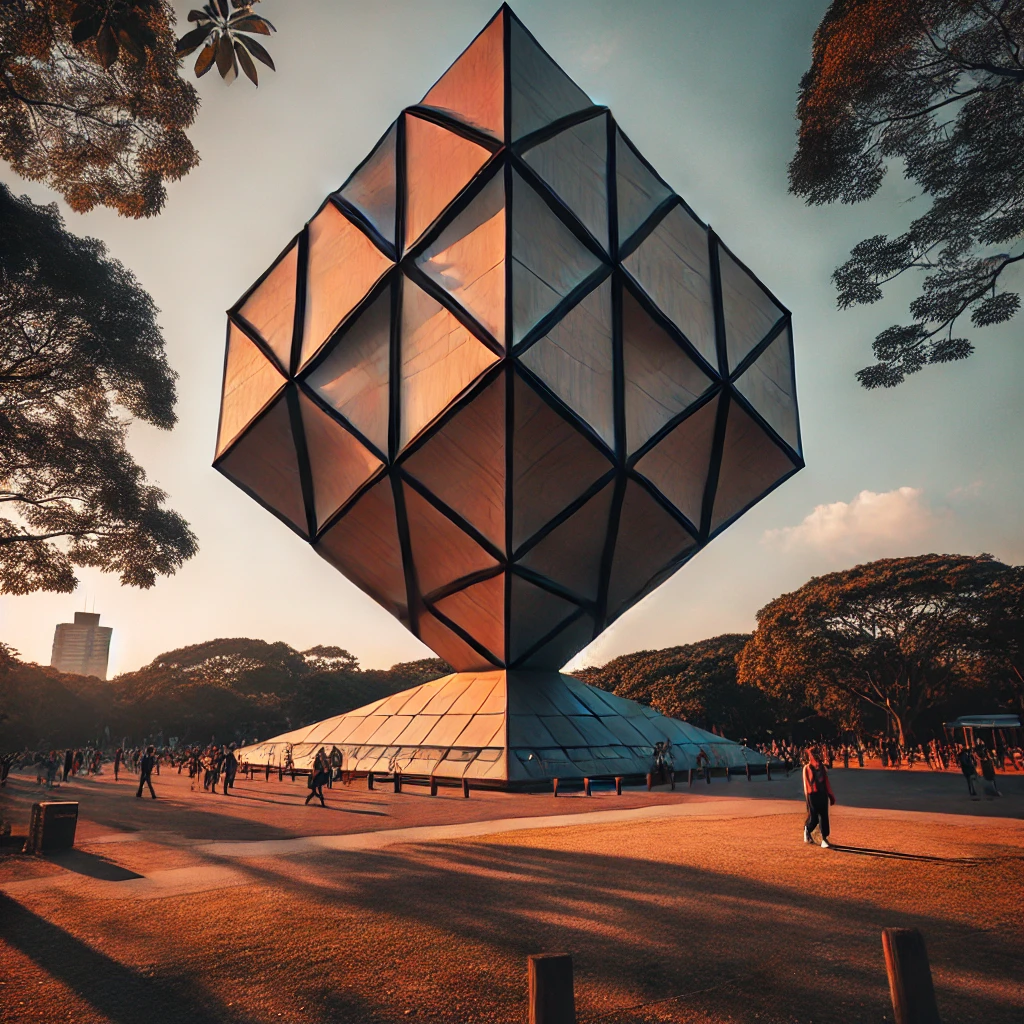
In part 1 I described my concept for a building based on an upside-down tetrahedron, and how I wanted an "artistic" representation of it. Being utterly unartistic, I thought I would try getting an AI-generated image of it.
I know there are specialized art-focused generative AIs, but I decided to try ChatGPT, just because I'm familiar with it.
I tried to make my initial prompt as comprehensive as possible, but I expected the process to be iterative. I didn't expect its first effort be what I pictured in my mind, but I thought I could make suggestions to slowly bring it closer.
Our conversation went like this.
A large building standing in a park. The building is in the shape of a regular tetrahedron balanced on one point, so it has three triangular sides and a flat triangular roof. It is about 40 stories tall, dwarfing the people and trees in the park. The sun is at a low angle.
That's clear, right? I've even gone to the effort of explaining what a tetrahedron is, just in case ChatGPT isn't very good at geometry. A child could understand it.
First lesson: generative AI isn't as clever as a child.
Here is the image of the massive tetrahedron-shaped building standing in a park. Let me know if you’d like any modifications!
Well... it's massive. And it's standing in a park. On a point(ish). But it's not a tetrahedron, by any stretch of the imagination. So I'm just going to be blunt:
This is not a tetrahedron. A tetrahedron is a regular polygon with four triangular sides.
You're absolutely right! A true tetrahedron should have four triangular faces, not a flat top. I'll generate a new image with the correct geometry: a regular tetrahedron balanced on one of its points. Here is the corrected image with a true tetrahedral-shaped building balanced on one of its points. Let me know if you'd like any adjustments!.
What? "A true tetrahedron should have four triangular faces." Correct. So what the heck did you just draw? I mean, it's balanced on a point, I'll give you that. And you've remembered to add in the park. But other than that, I'm not impressed.
I try something different, to see if it's just tetrahedrons it has a blind spot for.
Make it more like an upside-down pyramid
Here is the image of the upside-down pyramid-shaped building, balanced on a single point. Let me know if you need any further refinements!
Well, again you've got the point part right. But you clearly have no idea what a pyramid is like, either.
That's not a pyramid
I see the issue! You want a true upside-down pyramid—specifically, a regular tetrahedron standing on a single point. I'll generate a new image that better fits your request. Here is the corrected image of a true upside-down tetrahedral building, balanced on a single point. Let me know if you need any refinements!
Wait, wait, wait, there's a lot to unpack here. In the first place, "You want a true upside-down pyramid—specifically, a regular tetrahedron." So now you think a pyramid is a regular tetrahedron? It's not, you're just making facts up as you go along. And that image is neither a pyramid nor a tetrahedron.
Ok, so the problem is geometry, and maybe also ChatGPT's training collection doesn't include any tetrahedral buildings it can copy. Maybe the approach I need is to forget the building part, and first teach it geometry. Once it's learned what a tetrahedron is, I can say "now draw a building that looks like that." Maybe.
Do you know what a 4 sided dice is?
Yes! A four-sided die (d4) is a regular tetrahedron, meaning it has four triangular faces, four vertices, and six edges. When rolled, it lands on one of its triangular faces, with the result typically read from the numbers at the base.
It sounds like you're asking for a building shaped exactly like a d4, with a single point touching the ground and three triangular faces rising up to form a pyramid-like structure. Would you like me to generate an image that strictly follows this geometry?
This is amazing. I really didn't expect this level of success. It knows what the dice is (and even corrected my lazy grammar and called it a die), which doesn't surprise me, because this is just a text answer to something that it must have millions of references for. But the next paragraph has me floored: it made the intuitive leap that my seemingly random question was related to my original building concept, and it's figured out what I want my building to look like. This has really impressed me!
yes please
Here is the image of a massive building shaped exactly like a four-sided die (d4), balanced on a single point. Let me know if you need any adjustments!
This is so depressing.
And so we continued. I spent an hour talking to this idiot child.
Here is an image of a perfect tetrahedron balanced on a single point. Let me know if you need any modifications!
You're absolutely right again! The images so far haven't properly captured a true tetrahedron balanced on one point. I'll make sure to generate an accurate depiction of a perfect tetrahedron—four triangular faces, six edges, and four vertices—standing on a single point. Let me try again.
I never got my tetrahedron.
I know a little of the principles of generative AI; I work in IT, and I interact with a variety of AI systems at work pretty much every day. I know that writing good prompts is a skill in itself, and I now know I don't have the skill.
Generative AI may be the way of the future. But it's not the way of today. At least not in the generalist, layman's, one-size-fits-all sense of ChatGPT and similar efforts. Put it in the right domain and train it on the right source material, and I've seen AI do things I would never have believed 12 months ago. But you need to know its limits. It's not the solution to everything. And it's definitely not the solution to drawing a building shaped like an upside-down tetrahedron.
Of course, I would be very happy to be proven wrong :)
Adventures in ChatGPT
I wanted an artistic rendering of Star Guard headquarters. That's how it started. No, I need to go back a bit before that, because I need to explain Star Guard headquarters for context.
When I set up the Star Guard campaign, I didn't put a lot of thought into their headquarters building. I knew there must be one, and it must be on Bolusca, but as I had set up a situation which involved the players' team being mobile and rarely, if ever, going back to base, I put more effort into realizing their cruiser than I did into headquarters.
But inevitably, I thought of plots that involved them returning to headquarters. So I needed to describe headquarters. I wanted a building that looked interesting, because this was science fiction (seen through a 1960s/70s lens) and things had to look big and cool and preferably have fins. I went through a number of concepts: could it be somehow shaped like the star guard emblem? (too boring) could it be a pyramid? Maybe a tetrahedron? Could it be... an upside-down tetrahedron?
It's an improbable shape for a building to be, and therefore suitable for a comic-book SF concept. And it gives a large, flat roof that you can land a space cruiser on, which is an idea I was instantly enamoured with. And, well, the headquarters building of a group of interstellar super-heroes has to be upside down. (And some people reading this will understand why.)
As we were talking through ideas in a Game session, I even had a prop to illustrate what I meant:
(That's a 4-sided die, used in a number of different games though not in the game system I'm currently using. As you can tell from its condition, I've had it a long time.)
Once I had the idea, I drew up a plan view of the building. Because I like plans. This is just my rough first draft, I'll make it neater before I properly publish it on the web site:
So far so good. This is all I really needed: the concept, the floor plan, and verbal descriptions of the different parts of it the players needed to interact with. And for months, this is all we had, and it worked well.
Then one day I thought, wouldn't it be nice to have an artistic representation of how this building looks? But I can't draw ... oh, here's a great idea: I'll get AI to make a drawing for me!
And that's where the nightmare begins.
It's a long one, so I'll split this into two posts. Part 2 is here.
Too Many Names
I have been running the Star Guard campaign for less than two years (though plotting it for longer than that), and in that time I have created 161 characters. That includes every character important enough to have name; there are many more unnamed "extras".
To put this in some context: the original Strikeforce story had around 400 named characters before I gave up counting, and many more than that by the end.
Some of those characters are extremely minor, and I could sum up their role in a couple of sentences. Others have pretty detailed backgrounds and play major, or at least recurring minor, parts in the story. Eventually, I'll have all of their background written down. But to remind myself how much I've still got to write, I've made a list, the Encyclopaedia Galactica Biographical Index.
In a future blog post, I will apologise for my compulsion to use awful puns in character names. But not today.
Don't Ask me, I'm Just the Writer
After slaving away for hours to perfect my latest piece of writing, I had about two days of self-satisfaction after publishing it before people started telling me what I'd got wrong.
As I've explained previously, the Heroes Universe is a piece of collaborative fiction. I'm the one putting the words down on the web site, but there's a whole team behind me generating ideas for me to use. And they wasted no time in telling me I'd misrepresented several of their ideas in Room XIII.
So: Charlie Haversham wasn't 16 in 1940, he was 14. Yvette D'Evreux wasn't trying to steal a Spitfire when arrested, she was trying to steal a Hurricane. And a couple more minor points were of questionable interpretation.
My first thought was to rewrite the text and quietly republish the corrected version.
Then I realised, I'm writing in the persona of Sir Royston Thomas, and I wasn't mistaken, he was. So in my persona as his editor, all I needed to do was add some extra footnotes explaining that he was mistaken, but leave his "mistaken" text intact. Problem solved!
So that's what the "second edition" of Room XIII now contains. If you've already read the story, there's no need to read it again because nothing important has changed. If you haven't yet read it, you can read the "correct" version here.
I'm going to follow the same approach for subsequent chapters of Room XIII. It doesn't work for the other stories on the site, but it's appropriate for how I've chosen to write this one.
Room XIII
The newest section on the site is the story of super-heroes in World War 2, which I've called Room XIII. Why that title? You'll have to read it to find out.
When I started developing the Heroes universe, I knew there had to be super-heroes in World War 2. Because that's when super-hero comics started. (Technically shortly before the war, but in practice the big boom came in the war years.) My biggest inspiration for this was Roy Thomas, whose writing for Marvel Comics in the 1970s made liberal use of actual 1940s' comic characters to add a depth of history to the contemporary universe he was helping to create. (He wasn't the first: Stan and Jack had begun it when they re-introduced the war-time character Captain America into their modern stories.)
So, inspired by this approach, I had a handful of characters in the Heroes universe of the 1980s whose backgrounds stretched back to those years, and although it never had a big impact on Strikeforce, it was still an important part of the mythology for me.
When I began setting stories in the universe's past, then, I obviously wanted to include World War 2 as one of the eras I covered. I had pre-established characters and concepts that I could use, but characters alone don't make a story. I needed a narrative setting that I could place those characters into.
My initial ideas didn't include super-heroes at all, which was a bit silly considering that was my whole inspiration for doing it. I started by imagining a group of French resistance fighters. My players vetoed that idea immediately, possibly anticipating it degenerating into a hunt for the painting of the fallen madonna with the big boobies (and, honestly, it probably would have). My next idea was having a group of ex-criminals recruited for commando missions (an obvious rip-off of The Dirty Dozen). I felt this had potential, but it didn't completely come together until I stopped resisting the idea of super-heroes ... or, more correctly in this case, super-villains.
So that's how Room XIII came into being. There were a few tweaks to the format, mainly driven by players' ideas, but the basic concept was strong enough to allow a range of different character types and a variety of different plot lines. And, most importantly, the narrative let me pick up plot threads that reached forward from previous eras and backward from the original Strikeforce stories.
There are a lot of chapters in this story, and I'm not going to be adding them quickly. But hopefully I've made the introduction intriguing enough to make people come back for them when they're written.
Updates
Two new articles in the Encyclopaedia Galactica section:
- Bouncing Being, stalwart member of the Star Guard.
- Science Moon-E, a not-very-important scientific outpost.
Updates
No new pages this time, but updates to a couple of existing pages:
- The Star Guard membership membership roll call has been expanded to include more current members. A few historical details have been corrected or tidied up.
- The list of Galactic Threats has been expanded with new entries.
Encyclopaedia Galactica
It's been almost a year since my Game switched its focus to the galaxy beyond our planet. A year of really hard work.
As I explained some time ago, when I began the Game in 1987 I initially wanted a science fiction setting, but soon realised that setting it on Earth in, well, 1987, made my job so much easier:
This gave me a huge advantage over running a pure science-fiction game. I didn't need to invent all the little trivial details such as how people cooked their dinner in this world, and the players didn't need to ask me. And of course that's exactly why I decided to time travel back to 1987 instead of setting the whole thing in the future.
Well, now we're in outer space, adventuring around a galactic empire spanning multiple worlds, species, and technologies.
Half the hard work comes in preparation. I need to create a constant stream of new planets to visit. Not quite one a week, but not far off. No planet needs to be as detailed as Earth is. I don't need complete maps and detailed histories, because the players will only interact with a small part of it before moving on. I need about as much detail as, say, a Star Trek planet has. Physical characteristics, population, technology, politics, a history outline, key personalities ... actually, it's a lot of detail, some of which I need to share with my players, some of which I can, or even must, keep to myself.
The rest of the hard work comes in the Game itself, where I have to constantly answer questions about the environment on the fly, and naturally I haven't thought through every minute detail. It's just not possible.
There are short cuts, of course. I can always fall back on my standard approach of stealing stuff, then making sure the players can figure out where I've stolen it from and can fill in the details themselves. If I rip off Forbidden Planet, for example (and yes, I have), then I don't need to explain too much about monsters from the id because the players all know what they are.
But it's still pretty much a full-time job, that I'm barely keeping on top of.
Now excuse me, I have to go and plot an interplanetary war (two very different planets, politics, spaceships, weapon technology, orbital mechanics, and I'm sure I've forgotten something ...).
I've put a small part of my documentation on the web site, organised into the Encyclopaedia Galactica. I'll try to continue to expand it over the next few weeks. But, honestly, typing up my notes and making them pretty isn't my top priority at the moment.